
Missing teeth can affect more than the appearance of your smile. They may make chewing difficult, affect speech, change your bite, and influence the position of nearby teeth. Fortunately, modern dentistry offers several ways to replace missing teeth, with dental implants and dental bridges being two of the most commonly considered options.
If you are trying to decide between a dental implant and a dental bridge, there is no single option that is best for everyone. The right choice depends on factors such as your oral health, jawbone condition, number and location of missing teeth, treatment time, budget, and personal preferences.
At Centre For Smile Dental Clinic Jaipur, a detailed dental examination can help determine which tooth-replacement option is most appropriate for your individual needs.
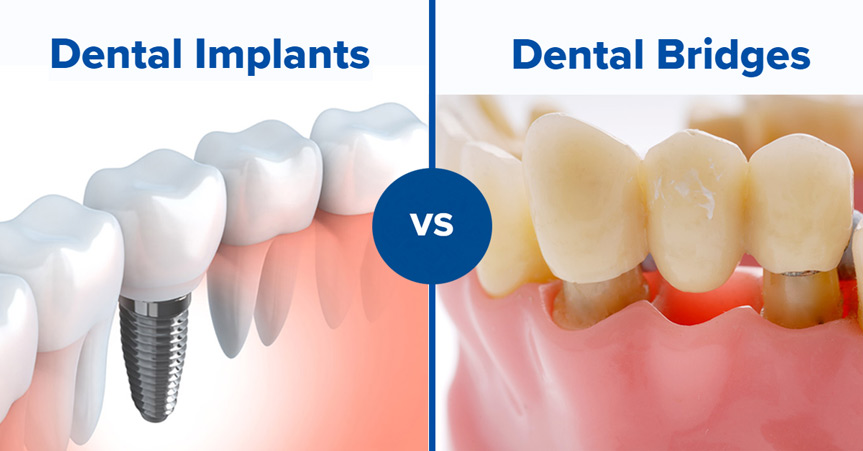
What Are Dental Implants?
A dental implant is a tooth-replacement option designed to replace a missing tooth from the root upward. An implant is surgically placed into the jawbone and, after healing, supports a dental crown that resembles a natural tooth.
Dental implants can be used to replace a single missing tooth, several teeth, or, in selected cases, support restorations for multiple missing teeth.
One important advantage of an implant is that it generally does not require neighbouring healthy teeth to be prepared solely to support the replacement tooth.
Benefits of Dental Implants
Dental implants offer several potential benefits:
- They can closely resemble the appearance and function of natural teeth.
- They do not usually require alteration of adjacent healthy teeth.
- They help provide stable support for replacement teeth.
- Implants can help preserve stimulation of the jawbone in the area of the missing tooth.
- With appropriate care and regular dental follow-up, implants can be a long-term tooth-replacement option.
- They can improve chewing ability and confidence when smiling.
However, implant treatment involves a surgical procedure and requires sufficient bone and healthy oral tissues. The overall treatment process may also take several months depending on healing and the complexity of the case.
What Is a Dental Bridge?
A dental bridge is a fixed dental restoration used to replace one or more missing teeth. As the name suggests, it “bridges” the space created by missing teeth.
A traditional dental bridge commonly uses teeth on either side of the gap as support. These supporting teeth are prepared to hold crowns, while an artificial replacement tooth fills the missing space.
Different types of bridges are available, and the most appropriate design depends on the location of the missing tooth, condition of neighbouring teeth, bite, and other clinical factors.
Benefits of Dental Bridges
Dental bridges also offer several advantages:
- They can restore the appearance of missing teeth.
- Treatment is often completed faster than implant treatment.
- Traditional bridge placement generally does not require implant surgery.
- They can restore chewing function and help maintain the alignment of surrounding teeth.
- Bridges may be suitable for patients who are not appropriate candidates for implant surgery.
- In some situations, the initial treatment cost may be lower than that of an implant.
A potential consideration is that traditional bridges usually require preparation of neighbouring teeth, even when those teeth might otherwise be healthy.
Dental Implants vs Bridges: Key Differences
Understanding the main differences can make it easier to discuss your options with your dentist.
1. Treatment Approach
A dental implant is placed into the jawbone and supports a replacement tooth independently.
A traditional dental bridge relies on adjacent teeth for support. These teeth are typically reshaped and covered with crowns that hold the replacement tooth between them.
If preserving untouched neighbouring teeth is a priority and the clinical conditions are suitable, an implant may offer an advantage.
2. Treatment Time
Dental bridges can often be completed in a shorter period because they do not usually require the same bone-healing process as dental implants.
Dental implant treatment may require several stages. After implant placement, time is often needed for healing and integration with the jawbone before the final restoration is attached.
Treatment times vary significantly depending on the individual case.
3. Durability and Longevity
Both implants and bridges can provide effective long-term tooth replacement when properly planned, maintained, and cared for.
Dental implants are designed as a durable solution and may last for many years with good oral hygiene and professional maintenance. However, the crown or restoration attached to an implant may eventually require repair or replacement.
Dental bridges can also function successfully for many years, but their longevity depends partly on the health of the supporting teeth and gums.
No dental restoration should be considered permanent without maintenance. Regular dental examinations remain important for both options.
4. Effect on Adjacent Teeth
This is one of the most important differences between implants and traditional bridges.
A single-tooth implant generally replaces the missing tooth without requiring neighbouring teeth to be reduced for support.
A traditional bridge typically requires the adjacent supporting teeth to be prepared for crowns.
However, if neighbouring teeth already have large fillings, damage, or require crowns for other reasons, a bridge may sometimes be a practical treatment option.
5. Jawbone Considerations
After a tooth is lost, the bone in that area may gradually change because it no longer receives stimulation from the tooth root.
Dental implants interact with the jawbone and can help maintain bone in the implant area.
Traditional bridges replace the visible missing tooth but do not replace the tooth root within the jawbone.
Bone condition is also important when considering implants. Some patients may require additional procedures, such as bone grafting, before or during implant treatment.
6. Cleaning and Maintenance
Dental implants are generally cleaned similarly to natural teeth, although special attention around the implant and gums is important.
Dental bridges require careful cleaning underneath the artificial tooth and around the supporting teeth. Special floss, interdental brushes, or other cleaning aids may be recommended.
Regardless of the option chosen, good oral hygiene is essential for protecting the gums, supporting teeth, implants, and restorations.
7. Cost
Cost is an important consideration when comparing dental implants vs bridges.
A dental bridge may have a lower initial cost in some cases. Dental implants can involve a higher upfront investment because treatment may include surgery, the implant component, an abutment, and a crown.
However, cost should not be considered in isolation. The condition of surrounding teeth, expected maintenance, additional procedures, and long-term treatment needs should also be considered.
A personalised dental consultation is the best way to receive an accurate treatment plan and cost estimate.
Dental Implant or Bridge: Which Is Better?
Neither option is automatically better for every patient.
A dental implant may be considered when you have adequate jawbone, healthy gums, suitable general health for the procedure, and want an independent replacement that does not rely on neighbouring teeth.
A dental bridge may be considered when you prefer a non-implant option, want a potentially shorter treatment process, have neighbouring teeth that can appropriately support a bridge, or are not a suitable candidate for implant surgery.
The decision should be made after a complete dental examination rather than based only on cost or convenience.
Who May Be a Good Candidate for Dental Implants?
Dental implants may be suitable for adults who have one or more missing teeth, healthy gums, sufficient jawbone or the possibility of bone augmentation, and the ability to maintain good oral hygiene.
Certain health conditions, medications, smoking or tobacco use, gum disease, and insufficient bone may affect implant planning or healing. These factors do not always rule out treatment, but they should be discussed with your dentist.
Who May Be a Good Candidate for a Dental Bridge?
A dental bridge may be suitable for patients who have one or more missing teeth with appropriate supporting teeth nearby.
The supporting teeth and gums must be carefully assessed because the success of a traditional bridge depends heavily on their long-term health and stability.
Your dentist will evaluate your bite, tooth condition, gum health, missing-tooth space, and other factors before recommending a bridge.
How to Choose the Right Tooth-Replacement Option
When deciding between a dental implant and a bridge, consider factors such as:
- Number and location of missing teeth
- Health of adjacent teeth
- Jawbone quantity and quality
- Gum health
- Overall medical health
- Treatment duration
- Oral hygiene habits
- Budget and long-term maintenance
- Personal treatment preferences
Dental X-rays or other imaging may also be required to evaluate the bone and surrounding structures before finalising treatment.
Dental Implants and Bridges in Jaipur
Replacing missing teeth can help restore your smile, improve chewing function, and support better oral health. Both dental implants and dental bridges can be effective solutions when selected and planned appropriately.
At Centre For Smile Dental Clinic Jaipur, patients can receive an individual dental assessment to understand the available options for replacing missing teeth. Your dentist can evaluate your oral health, explain the advantages and limitations of each treatment, and recommend an option based on your specific dental needs.
If you have one or more missing teeth and are wondering whether a dental implant or dental bridge is better for you, schedule a dental consultation for a personalised evaluation.
Conclusion
The choice between dental implants vs bridges depends on your individual circumstances.
Dental implants offer an independent tooth-replacement option, can help maintain jawbone stimulation, and usually avoid preparing neighbouring healthy teeth. Dental bridges may offer a faster, non-implant solution and can be appropriate in many clinical situations.
Rather than choosing based on a general comparison alone, consult a qualified dental professional who can assess your teeth, gums, bone, bite, and overall dental health.
With the right treatment plan and proper oral care, replacing missing teeth can help you regain function and enjoy a healthier, more confident smile.
